Introduction
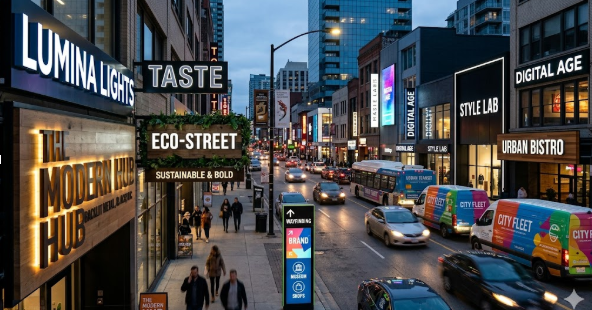
Walk down any busy street in Surrey, Richmond, or Downtown Vancouver today, and you’ll notice something different. Signs aren’t just names on walls anymore. They’re glowing, interactive, dimensional, and designed to stop people mid-step.
The signage industry is evolving faster than ever, driven by new technology, changing customer expectations, and a growing push for sustainability. For BC business owners, staying ahead of these trends isn’t just a design decision — it’s a competitive one.
Here are the biggest signage trends shaping 2025, and what they mean for your business.
1. LED and Illuminated Signs Are Now the Standard, Not the Upgrade
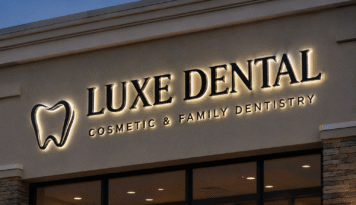
If you’re still running fluorescent backlit signs, you’re already behind. Across Metro Vancouver, LED signs for business have become the default — and for good reason.
LED illumination uses significantly less energy than traditional lighting, lasts longer, and delivers brighter, more consistent visibility day and night. In BC’s dark winters, where daylight disappears by 4:30 PM, an unilluminated sign is practically invisible for half your operating hours.
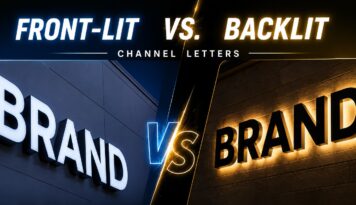
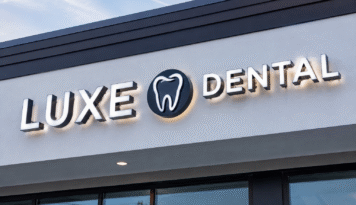
Beyond energy savings, modern LED channel letters and lightbox signs allow colour customisation, dimming controls, and even remote management. Whether you run a restaurant in Burnaby or a dental clinic in White Rock, illuminated signage is one of the highest-ROI upgrades available right now.
2. 3D and Dimensional Signs Are Replacing Flat Graphics
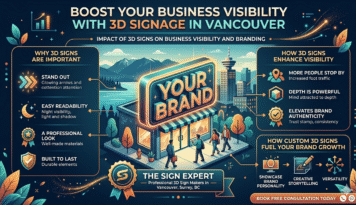
Flat printed signs are losing ground. The trend across retail, hospitality, and professional services is toward 3D business signs — raised lettering, layered materials, and depth that flat panels simply can’t achieve.
Why the shift? Because three-dimensional signs create visual contrast that reads from further away, looks premium at close range, and photographs dramatically better — which matters in an era when customers share storefronts on Instagram and Google Maps photos.
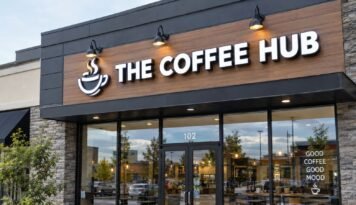
Popular combinations in 2025 include brushed metal lettering mounted on acrylic panels, foam-core letters with painted finishes, and backlit acrylic with dimensional logos. A sign maker in BC experienced with mixed-material fabrication can layer these elements to match your brand aesthetic and budget.
3. Minimalist Design With Maximum Impact
Cluttered signs — packed with taglines, phone numbers, websites, logos, and secondary messaging — are being replaced by cleaner, bolder approaches. The minimalist signage trend is driven by one insight: people make split-second decisions about whether to engage with a sign at all.
Clean typography, high-contrast colour palettes, and a single focused message outperform information-dense designs in almost every real-world setting. This is especially true for businesses on high-speed roads in Surrey or Langley, where drivers have less than three seconds to register your brand.
Minimalism doesn’t mean boring. It means disciplined — letting your brand name and core message breathe, with materials and lighting doing the heavy visual lifting.
4. Sustainable Signage Is Becoming a Business Expectation
Environmental responsibility is now a factor in how customers perceive your brand — and in how municipalities evaluate commercial development applications. Across BC, demand for eco-conscious commercial signage solutions is growing steadily.
This shows up in several practical ways:
Recycled and low-impact materials — recycled aluminium frames, PVC-free substrates, and sustainably sourced wood panels are increasingly available and competitively priced.
LED lighting — beyond cost savings, LED systems reduce energy consumption dramatically compared to neon or fluorescent alternatives.
Longevity over replacement — investing in weatherproof, durable signs that last 10+ years is inherently more sustainable than replacing budget signs every 3–4 years.
For businesses pursuing B-Corp certification, municipal grants, or simply wanting to reflect their values through their brand environment, sustainable signage choices are becoming a meaningful differentiator.
5. Wayfinding Is Being Treated as a Brand Experience, Not an Afterthought
Wayfinding — the system of signs that guides people through your space — used to be an afterthought. In 2025, it’s being recognised as a critical part of the customer experience, especially in retail, healthcare, multi-tenant buildings, and hospitality.
In Vancouver and Surrey, new mixed-use developments and commercial complexes are investing in cohesive wayfinding systems that match the building’s design language rather than defaulting to generic directories. The shift: from functional-only to functional and branded.
This means wayfinding signs that use your brand fonts and colours, material finishes that complement your interior design, and clear information hierarchies that reduce customer confusion before they even reach your staff. A professional signage company Vancouver team approaches wayfinding as an integrated design system, not a separate sign order.
6. Vehicle Wraps as a Core Fleet Branding Strategy
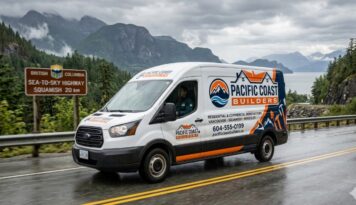
Vehicle wraps have gone from a nice-to-have to a standard part of brand strategy for BC service businesses. Plumbers, landscapers, contractors, electricians, and delivery companies across the Lower Mainland are realising that a wrapped fleet is a 24/7 mobile billboard — one that reaches the exact neighbourhoods they serve.
The trend in 2025 is toward full, high-coverage wraps with bold, clean design — moving away from the minimal decal approach that dominated a decade ago. Combined with modern cast vinyl materials that handle BC’s wet climate well, a professionally wrapped fleet can maintain a premium appearance for 5–7 years.
For businesses operating multiple vehicles, fleet consistency matters as much as individual impact. Matching wraps across a fleet signal professionalism and scale that individual decals never achieve.
What’s Not Trending (And What to Avoid)
Every trend list should include what’s falling out of favour:
- Generic banner signs left up year-round — both visually tired and often bylaw non-compliant in Surrey and Richmond after 90 days
- Cheap printed foam board signs — weather destroys them quickly, and they signal budget over quality
- Overcrowded fascia signs with multiple logos, taglines, and competing messages
- Non-weatherproof materials in outdoor applications — BC’s rain will find every weakness
A reputable sign company Surrey BC or sign shop near me will flag these issues at the design stage, not after installation.
The Compliance Reminder No Trend Blog Mentions
Trends matter. Permits matter more. In Vancouver, Surrey, and across BC, new signage — however stylish — still requires approval for most exterior applications. LED upgrades, dimensional installations, and new fascia signs all typically trigger permit requirements.
The Sign Expert handles the full permitting process alongside fabrication and installation, ensuring your trending new sign is also a compliant one. Review cycles in Metro Vancouver take 2–6 weeks, so building that timeline into your project from day one is essential.
Stay Ahead With the Right Signage Partner
Following trends is straightforward. Executing them well — with materials that hold up in BC’s climate, designs that comply with local bylaws, and installation that passes inspection — requires expertise.
Whether you’re refreshing one storefront or rebranding a multi-location operation, get a free sign quote that includes permitting, engineering, and installation transparently outlined from the start.
FAQ — Frequently Asked Questions
Are LED signs worth the higher upfront cost in BC? Yes. LED signs consume up to 75% less energy than fluorescent alternatives and last significantly longer. In BC, where hydro costs and dark winter months are both factors, the payback period for LED upgrades is typically 2–3 years.
Do 3D signs require special permits in Vancouver or Surrey? Yes. Dimensional signage that is structurally mounted to a building typically requires a sign permit, and in some cases, a structural engineering report. The Sign Expert manages this process for you.
How do I know which signage trends fit my business? It depends on your industry, location, budget, and brand. A restaurant on a busy Surrey arterial road has different needs than a law firm in a Vancouver office tower. A professional consultation helps match the right trend to your specific context.
Can I upgrade my existing sign to LED without full replacement? Often yes. Many fluorescent lightbox signs can be retrofitted with LED modules at a fraction of full replacement cost. A sign inspection will determine whether your cabinet is structurally sound for retrofit.
What’s the most cost-effective signage trend to start with? For most small businesses, illuminated channel letters or a dimensional fascia sign with LED backlighting delivers the best visibility-to-cost ratio. It’s the upgrade that most reliably increases foot traffic and perceived brand quality.